

Behind The Curtain: Making Magic and Technical Triumphs with Richard Martin
27 November 2023
Step behind the scenes with Richard Martin (otherwise known as RM), International Technical Supervisor of Moulin Rouge! The Musical and Head of Technical Production at Global Creatures, as he reveals the secrets, challenges, and triumphs behind one of the world’s most spectacular productions.
Can you tell us a bit about your career and how you ended up here?
My technical career started a few years ago… in 1979. I worked at the Opera House in the technical department, then moved on to Opera Australia and worked with them for 10 years touring around Australia. In 1989, I was lucky enough to get a touring job with Cameron Mackintosh on Cats, then went on and did the original Phantom of the Opera at the Princess Theatre. After that, I went on to be the technical director for the Sydney Olympics in 2000. Following that, I started my company, Martin Production, which I’ve been running for the last 24 years. Since then, I’ve also spent some time with Global Creatures. I’ve managed to work all around the world doing musicals, not only in Australia, but also Asia, West End, Broadway. You name it — I’ve been there.
We heard you actually started out as a performer, how did you make the switch to technical work?
At the ripe old age of five I started performing on the stage, and soon realised that my interest was actually in setting up the show and making the show happen, not being in it… so I transferred over to technical!
What’s the most memorable show you’ve worked on?
The most interesting one was probably Phantom of the Opera back in 1990 because it broke so many conventions in adding stage automation to a show. But then of course, King Kong was awesome. Just making that show happen and appear on stage was a challenge.
What is the most challenging aspect of the job?
The most challenging thing about being a technical director is making sure this eclectic bunch of people stay happy, get what they need, and produce a wonderful show.

What’s the best part of your job?
My favourite thing, by far, about what I do is actually being there when the curtain goes up to see all the smiling faces in the audience. Seeing people having a wonderful time and knowing that I was just a small part of making all that happen.
How did your collaboration with Global Creatures start?
I’ve worked with Global Creatures since about 2010. I was asked to come along and help put together King Kong all those years ago, I’ve now been involved with many productions for Global Creatures.
My initial contact with Global Creatures was Carmen Pavlovic, who approached me to ask if I’d be interested in coming along and helping with King Kong. At that time, I had my company Martin Production running quite successfully. We were doing seven shows at the time and I thought Oh, my goodness, I can’t possibly go into another one. The project interested me so much and the idea of working with Global Creatures was very exciting, I actually stopped doing all the shows that I was doing, handed them on to other technical directors and came along to work for Global Creatures. After starting with King Kong, I went on to Muriel’s Wedding then Strictly Ballroom. I suppose the exciting thing was taking King Kong to Broadway a few years ago, that was wonderful to see an Australian made show open on Broadway.
What was it like tackling a production like King Kong?
Working on King Kong was actually managing to get the vision on stage, getting that creature to work exactly how the director wanted it. So we had several disciplines involved in that creature — we had stage automation, we had humans, we had puppeteers, we had voodoo operators — I mean, the animatronics inside the creature was incredible. It was quite a challenge coordinating all those disciplines to actually make that creature come alive on stage every night, but exciting.
In particular, I’ll never, ever forget opening King Kong on Broadway. That was a very special moment for everyone involved in that show. It was a hard journey to get there. It was a long journey. But we managed to get there, and wonderfully we received critical acclaim resulting in a Special Tony Award for the creation of the title character.
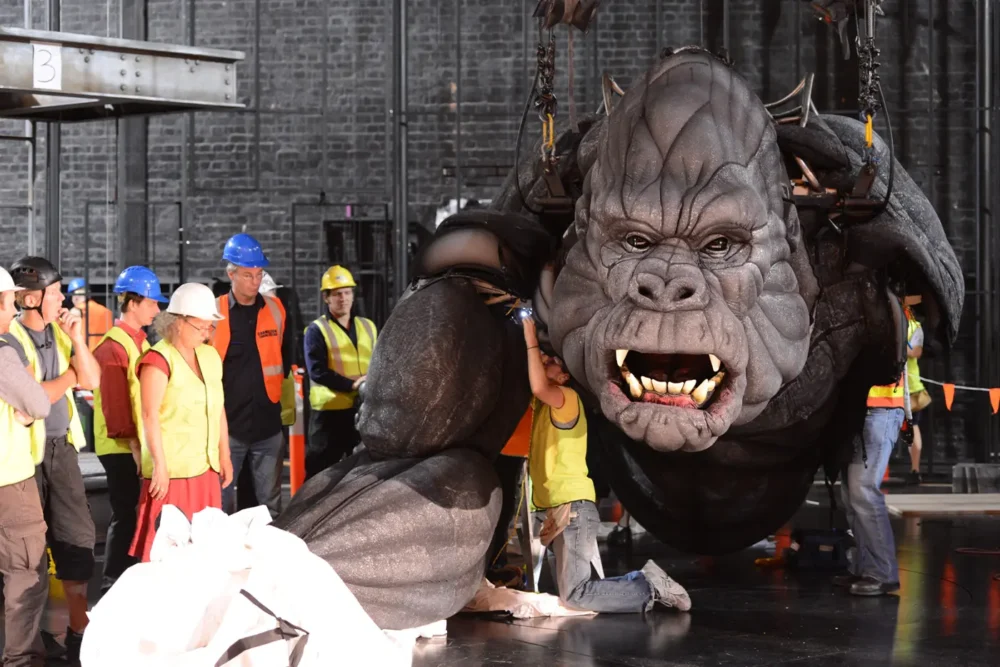
Installing the Kong puppet into the Regent Theatre. Photo by James Morgan.
13 years on, how has your work with Global Creatures has evolved?
Global Creatures has grown over the years with international success, and together we have adopted technologies to evolve how we create shows, Global Creatures are certainly open to being at the forefront of all that. So together it’s a nice collaborative partnership to produce these wonderful musicals.
What do you think makes up Global Creatures success?
The success of Global Creatures comes from their boldness, their initiative and fearlessness to go where no one else has gone. Writing and developing a new musical is not for the faint hearted but with Gerry Ryan and Carmen Pavlovic, they wish to bring new product to the audience and to the world of theatre. The only way to do that is, dare I say, “put your money where your mouth is”. Not everybody has that gumption, that initiative to get works out there that Global Creatures has… and they thrive from that. The people that work for them thrive to it. They take you along on the journey, it is the most exciting thing about working with them.
Can you explain what a Technical Director actually does?
Where does technical direction start in a production lifecycle?
People often ask me, “What do you actually do once the show loads in? Do you unload the truck? Or do you bolt the set together?”. I start planning some two years before the show actually gets to the theatre. We work with the creative team and the designers, we have to cost it up and get approval for those costs. My skills are in aimfully achieving the heights of what designers and creatives want within the producers means. So that’s a fine balance. As a technical writer, that’s my job and that all happens well before we get to the theatre. I ensure that everything’s organised well ahead of time. When the crew and all our technical teams arrive at the theatre, they have all the means, all the tools or the toys they need to actually put the show in.

What’s a ‘bump in’? Can you explain it for people who don’t know theatre lingo?
Just to explain the terminology we use in theatre, a ‘bump in’, which is also called a load in, a set up, a fit up, or take in, depending on which country you’re in, basically means bringing all the equipment needed from outside the venue into the venue and installing it exactly how the designers and creators wanted.
Tell us a little bit about bumping in a musical and what that process was like?
For Moulin Rouge! The Musical at the Regent Theatre, as it’s an older theatre, access is difficult and we were challenged by the space on stage. We had twenty-seven 48-foot semi-trailer loads of scenery, sound and lighting, costumes and equipment to maneuver onto the stage. It was an enormous challenge for everybody. In the early weeks it was critical that teams were organised into 24-hour shifts and that there was a schedule of what would come in and when it should come.

Installing the ‘Moulin Rouge’ sign, which required fifteen people to unbox. Photo by Vanessa Montalto.
Tell us a little bit about the equipment and the number of people that are needed to pull off a bump in for Moulin Rouge! The Musical?
We’ve had over 180 technical crew working backstage, front of house, up in the rehearsal room and with the band to facilitate the bump in of a show of this scale. We not only use the local theatre and technical staff, but we also have our touring team to support us, bringing in many talented people that have expertise in certain areas. An automation team of four come in just to look after automation. There’s also people from another workshop that come in to look after the elephant and the windmill. For audio, we have a team come in just to look after the audio equipment, as well as people for lighting and sound — they all have their own little discipline as different areas require certain expertise. My job is to make sure they’re all coordinated, and they all get on well together to create the show.
Can you walk us through the stages of a bump in?
The first thing to do is mark out the stage from our stage plans, then we put all the rigging up. Rigging comes first because that holds everything up. Next, we put the lights in, then the flown and suspended scenery. After that comes the show deck with all its automation. Once the show deck and the passerelle are in, we start to put the décor in — the pretty finishings that you see.
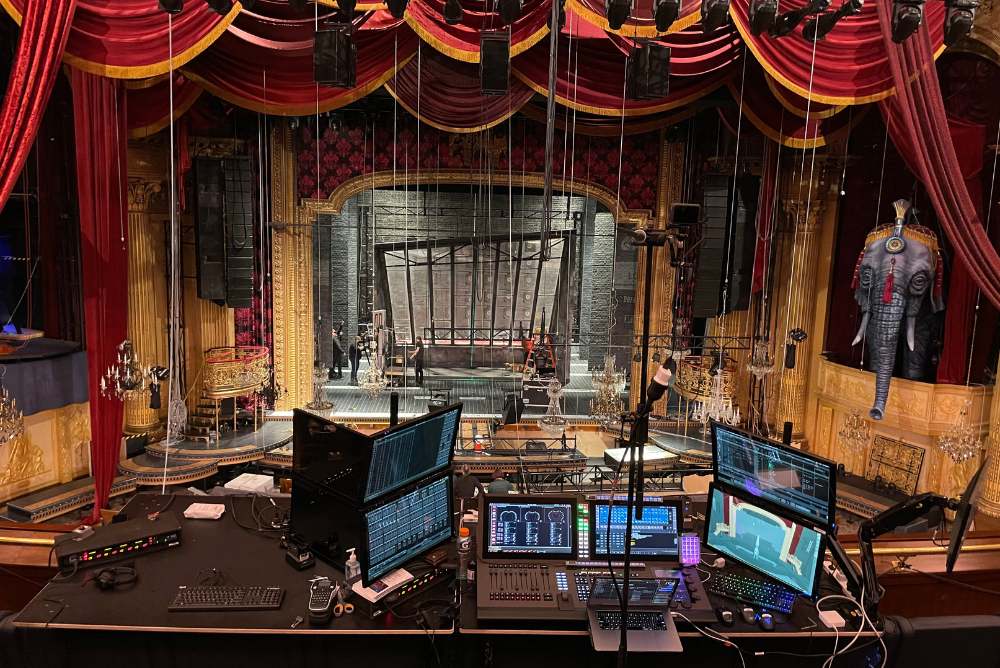
Bump in at the Regent Theatre, 2021. Photo by Vanessa Montalto.
Tell us about the automation and what’s happening under the stage.
With Moulin Rouge! The Musical we have an automated show deck. That’s not the real stage you’re looking at — the real Regent Theatre stage is 200-millimetres lower than the show deck. We have electric motors, pulleys, wires, cables, drag chains, electronics, speakers, and lights that actually work providing effects of this show. So whilst it might look like the crew are actually gliding the scenery on and off, it’s actually a computer controlling that. We mix in the theatre tradition of manual movement and scenery flying with automated effects.
You’d probably need five times as many crew to actually recreate that magic moment that the director and the designer wants to create. The problem being with five times as many crew, you’d see more crew on stage than what you would scenery. Nobody thinks about the computers and the motors in the floor driving scenery on and off stage. So the wow factor for the audience is the how did they do that? — it adds to the experience. Watching the set glide on and glide off to the exact moment in the music that the director wants, it creates the magic.
Who operates all that during a performance? Is it just ‘set and forget’?
Each night we have sixty odd crew working the show. The stage automation on Moulin Rouge! The Musical, like 99.9% of other musicals, is operated by a human. Whilst it’s a computer driving that motor on and off, it still relies on a human to push the button at the right time. The stage manager gives the cue at a certain point, bar, or music and the operator pushes those buttons. Whilst the automation has a driver, we also have our stage managers and stage crew observing the movement to make sure it’s doing what it should do, to make sure an actor is not in the way, or a group of people are not where they shouldn’t be, so that there’s no injuries to anybody.
Let’s talk about the safety.
Safety on large shows like this is paramount. The first thing I say to the crew is to always look for safety, safety and safety! It’s critical. It’s so easy to get injured if you don’t do what you were meant to do. This show is very tightly choreographed — just like the cast on stage, the crew need to be choreographed to do the same thing night in and night out. Not only so the audience see what they’ve paid to come and see, but so nobody gets injured because there’s a lot of heavy scenery moving at quite a pace back there. Once it’s all done how it’s meant to be done, it’s very safe. A bit like walking out on the footpath on the road. A car is doing 60 kilometres per hour down a road, you’re a meter away on the footpath — if the car stays on the road and you stay on the footpath, no problem. If they cross paths, it’s a disaster. Same here.
A key part of being a technical director, especially on such a large show, is the safety. We do risk assessments, we go into every single little element of what the creative team want us to do and ensure that we do it in a safe manner.

Once bump in is done, what’s next?
Once the show is set up, we test and adjust to make sure everything’s working like it should for our creative team. Then, we do what’s called a dry technical rehearsal, which is about teaching the crew how the scene changes go. We go through and check all the speeds of our automations, manual move scenery, and flying equipment. Once we know that’s all safe, then the cast join us on stage. After we do our cast onstage rehearsals, then we layer in the band and sound. During all this time, we’ve got costumes and makeup being added into the process. Then it’s onto dress rehearsal where we invite people along to see what we’re trying to achieve, hopefully with success.
Finally, it’s curtain up and preview time. That preview period is a time when the cast and the creatives, but particularly the cast get to feel and set their pace with the reactions to the audience. Testing moments where there’s laughter and they know when to cut the laughter off and when to keep going. That’s honed in by the directors, choreographers, and the music department. And then we get to what we call our opening night, which hopefully is the best we can possibly do the show.
Once the is show open and running, do you just come in and turn the lights on before a performance?
Each show day the team is in three hours before a performance. The crew come in and go through all their daily checks. We check every single piece of equipment, from the automation, the lighting, the sound, the stage scenery, the props. Our wardrobe department are in washing, ironing and mending, our wig team wash and restyle all the wigs, our sound department are re-battering all the microphones, etc. That’s our daily process
Once a week, we do a large maintenance, which is all about preventative maintenance. It’s checking all the machinery and equipment to ensure that it’s still as we installed it. We record all the data from the checks and can refer to them at anytime to review how we’ve maintained the show. If any issues in the future arise, we can look back at our records.
Has there been any significant maintenance on this show?
Recently, during the Korean production at the end of last year, there was a problem with our windmill. A component was failing on us and we had a show the next night. The windmill happened to be built here in Australia and luckily our Global Creatures COO was flying to Korea that very next day. We managed to courier the part from Brisbane to Sydney then got him to hand carry it to Korea. We installed it and voila! The windmill turned!
How important are the measurements?
During setup, measurements are critical. We’re talking millimetres here, some of the clearances backstage are literally millimetres apart. We work within a five millimetre tolerance and the designers like to work with one millimetre. It is not unusual if you’re up on the fly flow (that’s what the scenery fly in and out on) you think, oh my god that’s going to hit, but it doesn’t. It’s all well planned around that five millimetre tolerance. When Satine and Christian are on the on the couch they are literally centimetres from hitting the wall. If she has a leg or arm hanging over, she’d get caught on scenery. Christian’s watching to make sure he’s got her tucked in.
Is there anything people don’t think of that’s essential to a production?
Yes, air conditioning! It’s critical! During the show, we have specific settings to make sure the balance is right and air is circulating, because if it’s stuffed with a full house of cast, crew and audience during a performance… we’re in trouble.
What has made Moulin Rouge! The Musical different from other musicals you have worked on?
The passerelle, having the audience sitting in a captivated area at the Can Can tables is not something you see everyday. Normally our band would be in the orchestra pit, but here we have them secreted away up on level three and we have audience sitting in the pit area. The band being remote is a little unique, but modern technology it makes it all possible and so do our electronics! So that, along with all our the other front of house décor, our elephant, our windmill, and Satine’s magical entrance, the audience gets a very unique experience.
One of the most spectacular things is when the audience comes in and they realise what a transformation they are coming to see. It’s very unusual to have the environment transformed by the production coming into the audience, breaking what we call ‘the fourth wall’. Looking at those faces with sheer excitement is incredible and a real technical achievement.